Is Taiwan Rental Income Subject to 10% Withholding Tax or 2.11% NHI Premium?
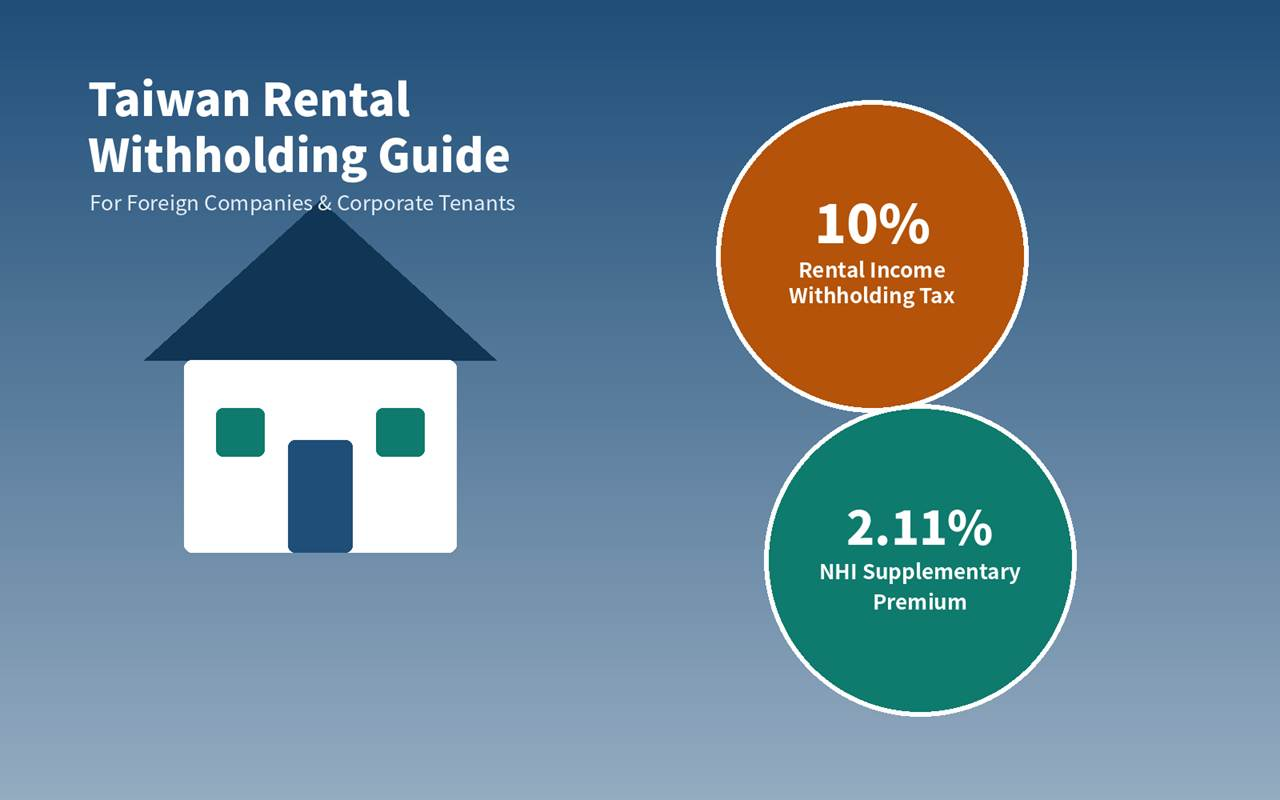
Rental payments in Taiwan can trigger both a 10% income tax withholding and a 2.11% NHI supplementary premium.
|
💡 30-Second Summary Companies renting an apartment for expat staff, or leasing office/retail space, often face two hidden costs: a 10% rental income withholding tax and a 2.11% NHI (National Health Insurance) supplementary premium. The trigger isn't how the property is used — it's who is paying. The thresholds also differ: the NHI premium applies once rent "reaches" NT$20,000, while the income tax only applies once rent "exceeds" NT$20,000. This guide includes full calculation tables, common misconceptions, and advanced scenarios like co-owned properties, overseas landlords, and foreign entities as tenants. |
Foreign companies renting apartments for expat staff housing, or startups and studios leasing an apartment as an office, almost always run into the same question: "Do we need to withhold tax from this month's rent? And how much?"
If the landlord is an "individual" (i.e., not renting under a company name) and the tenant is a company, firm, or licensed professional, the rent payment typically triggers two separate obligations — and the thresholds and calculations are different for each:
● Rental income withholding tax — 10%
● Second-Generation NHI Supplementary Premium — 2.11%
Many corporate finance teams, HR departments, and even landlords themselves confuse the two, assuming "it's always NT$20,000 that triggers withholding either way," or thinking "we'll just wire the full amount and let the landlord handle their own filing." This leads to miscalculated amounts, under-withholding, and eventually demands for back payment from the National Taxation Bureau or the National Health Insurance Administration — sometimes with late-payment surcharges. This guide walks through the decision logic, the calculation formulas, and the mistakes foreign companies and corporate tenants most often make.
Why This Matters Especially for Foreign Companies & Corporate Tenants
When an individual tenant rents a property purely for their own residential use, withholding obligations generally don't apply — the landlord simply collects rent each month. But whenever the paying party is a company, firm, agency, government body, school, or licensed professional, the tenant becomes a "withholding agent" under Taiwan law — regardless of whether the unit is used as an office or as staff housing. In plain terms: the tenant is acting on behalf of the tax authority and the NHI administration to collect tax and premiums from the landlord, rather than the landlord remitting them directly.
This matters especially for foreign companies for three reasons:
● Expat staff housing is typically leased and paid for by the company itself — the tenant of record is the company, not the individual employee. The withholding obligation is tied to "who is paying," not "what the unit is used for."
● Foreign companies usually operate under strict documentation and tax compliance standards. Under-withholding can trigger back-tax assessments and late-filing or late-payment surcharges during a tax audit.
● Many foreign companies are renting in Taiwan for the first time and have never encountered the "withholding agent" role. It's easy to assume the rent is simply the number written in the lease, or to mistakenly believe that if an employee "just lives there and isn't running a business," withholding doesn't apply.
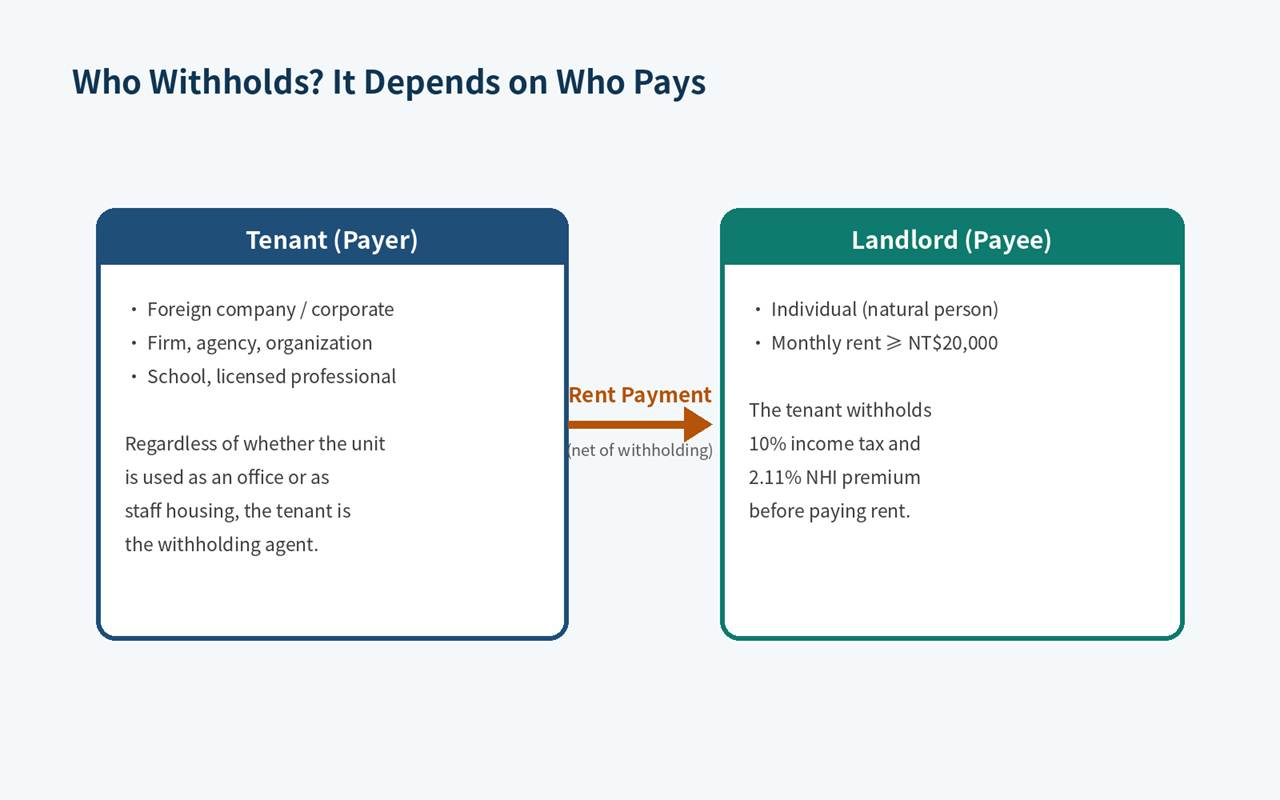
Whether withholding applies depends on the tenant's (payer's) identity — not on how the property is used.
When Does Withholding Apply? It Depends on "Who Pays," Not "How the Unit Is Used"
This is where most confusion — and most incorrect information online — comes from. Whether withholding applies depends on the identity of the rent payer (the tenant), not on whether the property is residential or commercial in use. Under Article 89 of Taiwan's Income Tax Act and the National Health Insurance Act, withholding agents are limited to government bodies, organizations, schools, business entities, and licensed professionals — not individual tenants.
Withholding is required only when all of the following are true:
|
Condition |
Details |
|
1. Landlord's status |
The landlord is an individual (natural person), not renting under a company or corporate name. If the landlord itself is a company, the landlord issues a Government Uniform Invoice (GUI) and reports the rent as its own business income — the tenant does not need to withhold. |
|
2. Tenant's (payer's) status |
The paying party is a company, firm, agency, government body, school, or licensed professional. As long as the entity signing the lease and paying rent falls into this category, it doesn't matter whether the unit is actually used as an office, a retail space, or staff housing — this condition is met. Conversely, if the paying party is an individual (regardless of how they use the property), withholding does not apply. |
|
3. Rent amount |
Monthly rent must reach a certain threshold (the two types of withholding have different thresholds — see below). |
|
⚠️ Common Misconception A common misconception is: "If the unit is used as a residence, withholding doesn't apply; only if it's used commercially does it apply." This is backwards. The real test is "who is paying the landlord," not "what the property is used for." When a company rents an apartment for expat staff housing, the employee's use is technically residential — but because the company is the party signing and paying, withholding still applies. The residential nature of the use does not exempt the company from this obligation. |
If any one condition is not met — for example, the landlord is itself a company, or the paying party is an individual rather than a company — neither the 10% rental withholding tax nor the 2.11% NHI supplementary premium applies.
Key Point: The Two Thresholds Are Different — This Is Where Most Errors Happen
This is the single most important concept in this guide, and the most common source of calculation errors:
|
Item |
Rental Income Tax (10%) |
NHI Supplementary Premium (2.11%) |
|
Threshold |
Monthly rent "exceeds" NT$20,000 |
Monthly rent "reaches" NT$20,000 (inclusive) |
|
Calculation basis |
Once the NT$20,000 threshold is exceeded, 10% is applied to the full rent amount |
Once the threshold is reached, 2.11% is applied to the full rent amount (not just the amount above the threshold) |
|
Withholding agent |
Tenant (company, firm) |
Tenant (company, firm) |
|
Cap |
No specific cap |
Capped at a single payment of NT$10,000,000 |
In other words, when monthly rent is exactly NT$20,000, only the 2.11% NHI supplementary premium (NT$422) applies — the 10% income tax does not. Only once rent "exceeds" NT$20,000 (i.e., NT$20,001 or more) do both withholding obligations apply simultaneously. This one-word difference — "reaches" versus "exceeds" — is the single most common mistake made by accounting staff handling this for the first time.
Complete Calculation Formulas & Examples
Assuming the landlord is an individual and the tenant (payer) is a company, here are calculations across common rent brackets (monthly rent, tax-inclusive):
|
Monthly Rent |
10% Income Tax? |
2.11% NHI Premium? |
Total Withheld |
Landlord Receives |
|
NT$18,000 |
No (below threshold) |
No (below threshold) |
NT$0 |
NT$18,000 |
|
NT$20,000 |
No (not "exceeding" 20K) |
Yes ("reaches" 20K) |
NT$422 |
NT$19,578 |
|
NT$25,000 |
Yes |
Yes |
NT$3,027.5 |
NT$21,972.5 |
|
NT$30,000 |
Yes |
Yes |
NT$3,633 |
NT$26,367 |
|
NT$40,000 |
Yes |
Yes |
NT$4,844 |
NT$35,156 |
|
NT$100,000 |
Yes |
Yes |
NT$12,110 |
NT$87,890 |
Formulas:
● Rental income tax = Monthly rent × 10%
● NHI supplementary premium = Monthly rent × 2.11%
● Amount landlord receives = Monthly rent − (income tax + NHI premium)
Take a monthly rent of NT$40,000 as an example: when the company pays the landlord each month, it should withhold NT$4,000 in tax and NT$844 in NHI premium from the NT$40,000, remitting both to the National Treasury and the NHI Administration. The landlord actually receives NT$35,156 — not the NT$40,000 shown in the lease. This should be spelled out clearly in the lease itself, using terms like "tax-inclusive" and "net amount," so the landlord doesn't assume they'll receive the full amount every month, which could otherwise lead to disputes later.
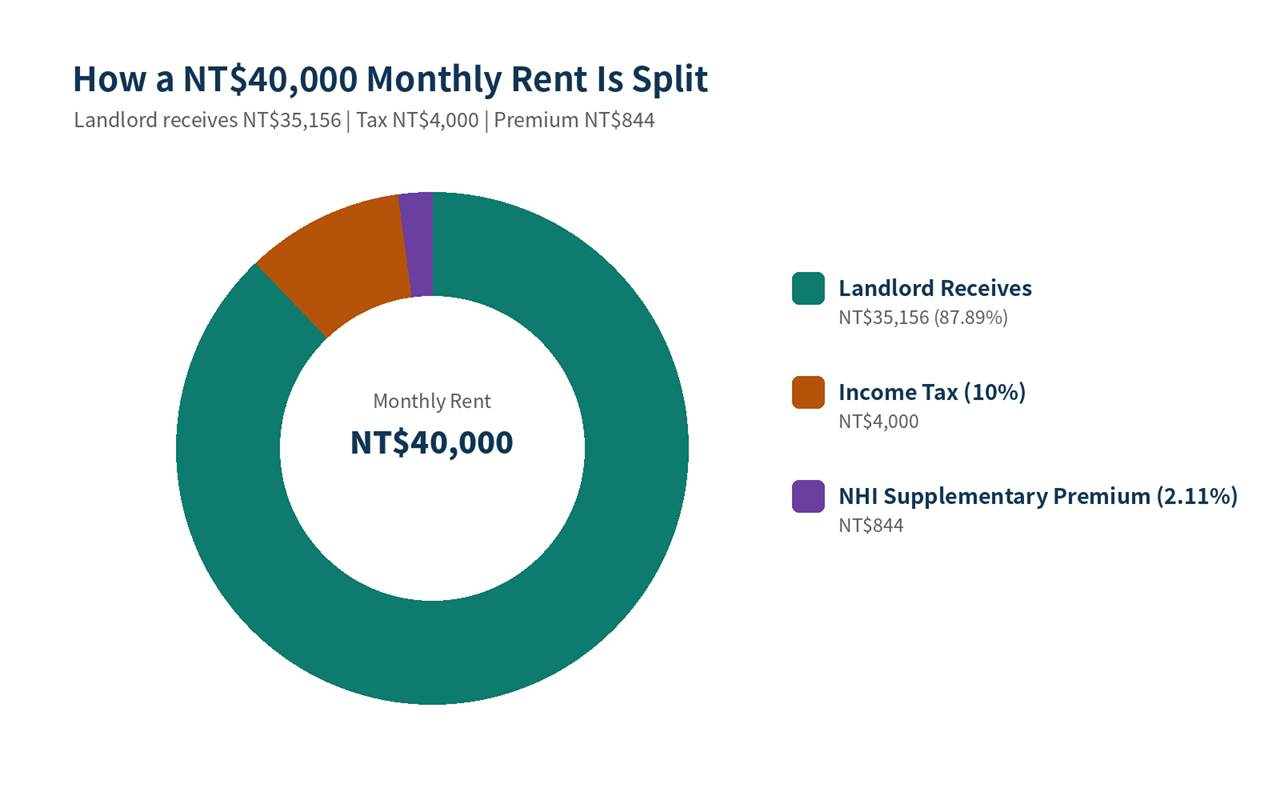
How a NT$40,000 monthly rent payment is split (landlord receives 87.89%).
|
🧮 Quick Formula + Free Calculator Amount landlord receives (net) = Rent (tax-inclusive) × 0.8789 |
9 Details Foreign Companies & Corporate Tenants Most Often Miss
1. "Staff Housing" Is Not Exempt Just Because It's Residential Use
This is the single most common misjudgment among foreign companies: many assume withholding only applies when a unit is used as an office, has an invoice issued against it, or is registered as a business address — and that staff housing, being "residential," is exempt. In reality, the obligation hinges on who signs and pays. As long as the company is the tenant, withholding still applies even if the unit is used purely for an employee's personal residence — the residential nature does not create an exemption.
2. Spell Out "Tax-Inclusive" vs. "Net" in the Lease
Many foreign companies write "monthly rent NT$40,000" in the lease without clarifying whether that's the landlord's net amount or the pre-withholding total. This creates mismatched expectations at payment time. It's best to state explicitly in the lease: "Monthly rent of NT$40,000 (tax-inclusive); after deducting 10% withholding tax and 2.11% NHI premium as required by law, the landlord receives NT$35,156 net per month."
3. The Company Must Issue Withholding Tax Statements
As the withholding agent, the company is required to issue an annual Withholding Tax Statement to the landlord and file it with the tax authority — not simply remit the withheld tax and consider the matter closed. Late or inaccurate filing can result in penalties against the company itself.
4. Splitting Payments Does Not Avoid the Threshold
If multiple payments are made to the same landlord on the same day (for example, rent and parking fees paid separately), they are still combined and treated as a single payment for threshold purposes. Splitting a payment cannot be used to avoid the NT$20,000 threshold.
5. Individual Landlord vs. Corporate Landlord — Completely Different Obligations
If the counterparty on the lease is actually a company (for example, a property management firm signing under its corporate name), individual withholding rules do not apply, and the tenant does not need to withhold 10% or 2.11%. However, the tenant should still confirm whether a Government Uniform Invoice is required as documentation. Always confirm the landlord's legal status before signing.
6. Watch for Changes to the "Annual Aggregate" System
Regulators had previously proposed shifting interest, dividend, and rental income to an annual-aggregate withholding system (triggered once cumulative annual payments exceed NT$20,000), but the Executive Yuan instructed that this reform be shelved in November 2025. The current "per-payment, NT$20,000 threshold" system remains in effect for now. If this reform is revisited and finalized in the future, the calculation method could change — companies leasing housing or office space for expat staff should keep monitoring official announcements to avoid using outdated or incorrectly reported rules.
7. What If the Landlord Is a Co-Owned Property with Multiple Owners?
If the rented property is registered under multiple co-owners, per a Ministry of Finance interpretive ruling (Tai-Cai-Shui No. 30682, issued in 1982), rental income must be calculated separately according to each co-owner's ownership share, regardless of who actually collects the rent — and a separate Withholding Tax Statement must be issued for each owner. In practice, if a given co-owner's allocated share of the rent falls below the NT$20,000 threshold, that portion typically does not require withholding — but this should be confirmed on a case-by-case basis using each owner's actual allocated amount.
8. Landlords Who Have Lived Overseas Long-Term (Non-Resident Individuals) Are Withheld Differently
Many landlords in Taiwan live abroad long-term. If this results in the landlord being classified as a "non-resident individual" for tax purposes (for example, present in Taiwan fewer than 183 days in the year, with their center of life and economic activity based elsewhere), the withholding treatment changes substantially: the income tax withholding rate is not 10% but 20%, and there is no NT$20,000 threshold — withholding applies to the full amount from the first dollar paid. As for the NHI supplementary premium, since it is levied only on NHI-insured individuals, a non-resident landlord who is not NHI-insured generally does not require the 2.11% withholding. Applying the resident-landlord formula (10% + 2.11%) to a non-resident landlord will likely result in under-withholding, which can later be assessed as a shortfall plus late-payment surcharges.
9. Does It Change If the Tenant Is a Foreign Representative Office or an Unregistered Foreign Company?
If the tenant is a foreign company not registered in Taiwan, or a foreign representative/liaison office, whether withholding applies depends on whether that entity falls within the scope of "government body, organization, school, business entity, or licensed professional" under tax law, as well as whether it has a tax registration or a fixed place of business in Taiwan — this cannot be assumed one way or the other. These cross-border cases may also involve bilateral tax treaties or diplomatic exemptions, so it's best to confirm on a case-by-case basis with an accountant or tax advisor to avoid a misjudgment that leads to back taxes or penalties.
|
🤝 Complex Case? Talk to a UR House Advisor First Items 7–9 above (co-owned properties, overseas landlords, and foreign entities as tenants) are exactly the kind of complex, case-specific situations where clear public guidance is hard to find. UR House has long supported foreign companies and foreign representative offices with Taiwan leasing matters, and has handled a substantial volume of real cases involving co-owner rent allocation, landlords treated as non-residents due to long-term overseas residence, and leases with foreign entities. Whether you're the tenant or the landlord in a situation like this, feel free to reach out to UR House's professional advisors first — we'll help confirm the correct withholding approach and reduce the risk of back taxes or penalties from a misjudged case. |
For Landlords: Necessary Expenses Can Still Be Deducted at Annual Filing
For landlords, the 10% income tax and 2.11% NHI premium withheld each month are not the final tax burden — they are a prepayment. When filing their annual individual income tax return the following year, landlords must still report the full annual rental income (the gross amount before withholding), and may deduct a standard allowance for necessary expenses (generally 43% of rental income) to arrive at taxable income, then credit the tax already withheld against the final tax due, with any difference refunded or additionally payable. The NHI supplementary premium already paid can similarly be included as an itemized health-insurance deduction (capped at NT$24,000 per person). In short, the monthly withholding amount and the final annual tax liability are calculated at two different levels — landlords shouldn't assume the amount withheld each month is their final cost.
Frequently Asked Questions
Q1: We rent an apartment for an expat employee to live in personally — does withholding still apply?
Yes. Withholding depends on who is signing and paying — not on how the property is actually used. As long as the company (a legal entity) is the one paying, and the landlord is an individual with rent at or above the threshold, withholding still applies, even though the employee's use of the property is purely residential.
Q1-2: So when does withholding NOT apply?
Withholding does not apply when the paying party is itself an individual (an ordinary personal tenant, not a company or firm) — regardless of how they use the property. It also does not apply if the landlord is itself a company, or if monthly rent is below the threshold.
Q2: If monthly rent is exactly NT$20,000, how much should be withheld?
Only the 2.11% NHI supplementary premium (NT$422) applies. The 10% income tax does not apply, because the income tax threshold requires rent to "exceed" NT$20,000.
Q3: If we make two separate payments to the same landlord in one month — for example, rent plus a management fee — how is this calculated?
Payments made to the same person on the same day are combined for threshold purposes. Splitting payments cannot be used to avoid the threshold; the combined total determines whether withholding applies.
Q4: We forgot to withhold and only realized later — what should we do?
File and remit the shortfall to the tax authority and the NHI Administration as soon as possible — earlier action reduces the risk of late-payment surcharges and penalties. It's advisable to consult an accountant or tax agent to help correct the filing.
Q5: If we lease through a property management company, do we still need to handle withholding ourselves?
If the property management company takes on the lease under its own corporate name and then subleases to the tenant, who bears the withholding obligation depends on the actual contractual structure. Confirm the contractual relationships and where the withholding responsibility sits before engaging a property manager, to avoid ambiguity among the three parties.
Q6: Could future changes to the NHI supplementary premium rate affect the landlord's net amount?
The NHI supplementary premium rate is not fixed permanently: it was 2% when the second-generation NHI system launched in 2013, was reduced to 1.91% in 2016, and was raised to the current 2.11% starting in 2021 — and it could be adjusted again in the future. If a lease simply states "monthly rent NT$40,000 (tax-inclusive)," the net amount the landlord receives will shift whenever the rate changes — and for higher-value leases (e.g., office or retail space at NT$300,000, NT$500,000, or NT$1,000,000/month), even a 1% rate change can mean thousands of NT dollars. It's worth specifying in the lease how the calculation basis and any future rate changes will be handled, to avoid disputes over the net amount later.
Conclusion
Rental withholding tax and the NHI supplementary premium might look like just two percentages, but because the thresholds and calculation bases differ — and because foreign companies' typical staff-housing or office leases tend to involve larger sums and more complex lease terms — it's easy to end up with under-withholding, missed filings, or mismatched expectations between the parties, especially in advanced scenarios involving co-owned properties, overseas landlords, or foreign entities as tenants. Whether you're the company about to sign a lease or the landlord renting out a property, it's worth confirming the withholding conditions, doing the calculation, and understanding the filing process before signing. You're also welcome to contact UR House's professional advisory team, who can help manage withholding, remittance, and the related documentation to reduce the risk of tax disputes down the road.